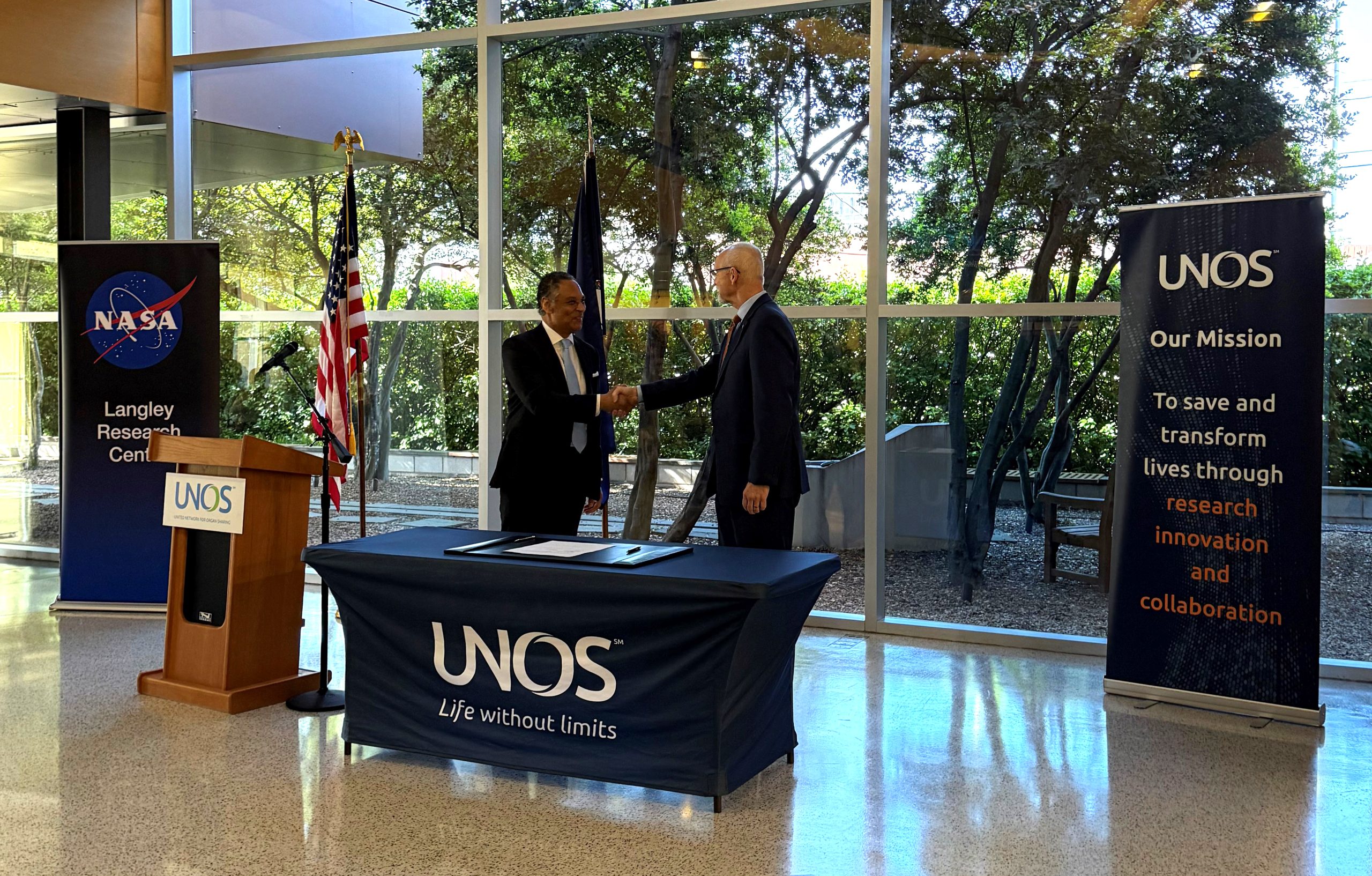
Mark Johnson, interim CEO of UNOS, and John Koelling, director of aeronautics research at NASA Langley Research Center, sign a partnership agreement to study drone transport for organs.
The United Network for Organ Sharing (UNOS) today announced a new partnership with the National Aeronautics and Space Administration (NASA) to advance the study of how drone technology could make organ transport safer, faster and more efficient.
The partnership was officially launched today during a signing ceremony at UNOS’ Richmond headquarters, beginning a joint effort to further our understanding of how unmanned, unpressurized aerial vehicle (UAV) flights affect organ viability, and explore how this technology could potentially transform the nation’s transplant logistics network.
This work combines NASA’s expertise in aeronautics and flight testing with UNOS’ deep experience in organ donation and transplantation to reimagine what it means to transport organs for transplant.
“This partnership shows what’s possible when innovation and mission-driven health care come together,” said Mark Johnson, UNOS interim chief executive officer. “By combining NASA’s aeronautics capabilities with UNOS’ transplant expertise, we can explore new approaches that may one day help reduce organ transport time and cost, improve efficiency and ultimately save and transform more lives.”
The first phase of this partnership will focus on developing and testing instrumentation to measure how environmental factors such as temperature, vibration, and altitude affect organs during UAV flights carrying research organs. NASA will also analyze potential flight routes, time savings, and ways drone technologies could be integrated into existing transplant logistics, focusing on a first-mile, last-mile route network.
UAV organ transport has the potential to reduce costs, increase routing flexibility, and cut transport times by avoiding traffic and other scheduling constraints.
“I couldn’t be more pleased to be a part of this,” said John Koelling, director of aeronautics research at NASA Langley Research Center during today’s signing ceremony. “Doing something in my backyard that could change the world—how cool is that? That’s almost as cool as stepping foot on the moon.”
Future phases of the collaboration are expected to explore scalability, longer-range flight testing, and regulatory considerations that could support the safe expansion of medical drone operations. The work will also involve collaboration with additional research partners, federal agencies and academic institutions.
UNOS has long supported innovation across the donation and transplant system beyond its role as a contractor for the Organ Procurement and Transplantation Network (OPTN). This partnership with NASA reflects UNOS’ commitment to exploring innovative solutions that strengthen the system.